How AI Helps Detect Cloud Misconfigurations Before Attackers Do

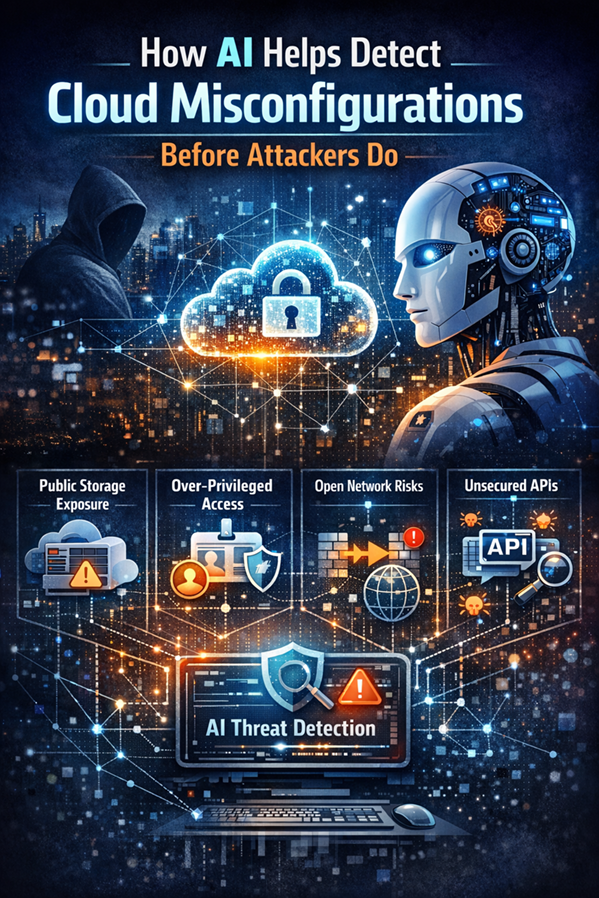
Image created with AI

Cloud environments provide speed and flexibility, but they also introduce new security risks. One of the most common causes of cloud breaches is misconfiguration. Public storage accounts, overly permissive identities, and open network rules can expose sensitive resources to attackers.

In large cloud environments, manually detecting these issues is difficult. Organizations deploy hundreds or thousands of resources across services like Azure App Service, Azure Storage, Azure SQL, and Azure Kubernetes Service. Security teams need automated ways to continuously monitor configurations and detect risks.

This is where Artificial Intelligence (AI) plays a key role.

The Misconfiguration Problem in Cloud Security

Cloud misconfigurations typically occur when resources are deployed with insecure settings. Common examples include:

  • Publicly accessible Azure Storage accounts
  • Excessive permissions inĀ Azure RBAC
  • MisconfiguredĀ Network Security Groups (NSGs)
  • Disabled logging or monitoring
  • Exposed APIs or services

Attackers continuously scan cloud environments looking for these weaknesses. Once discovered, they can quickly gain access to sensitive data or infrastructure.

Traditional security tools rely on static rules and manual audits, which are often too slow for dynamic cloud environments.

AI-Driven Detection in Microsoft Cloud Security

Microsoft integrates AI and machine learning into several security platforms to help detect cloud risks earlier.

Microsoft Defender for Cloud

Microsoft Defender for Cloud continuously analyzes Azure resources and configurations. It uses AI and threat intelligence to identify misconfigurations such as:

  • publicly exposed storage
  • unprotected virtual machines
  • excessive identity permissions
  • insecure network configurations

The platform also prioritizes risks using Secure Score and highlights exploitable attack paths across cloud resources.

Attack Path Analysis

A powerful capability in Defender for Cloud is attack path analysis. Instead of showing isolated issues, the system identifies combinations of misconfigurations that attackers could exploit.

For example:

  • an over-privileged service account
  • access to sensitive storage
  • external network exposure

AI helps correlate these signals and reveal potential attack paths before they are exploited.

AI and Identity Risk Detection

Identity is often the entry point for cloud attacks. Microsoft Entra ID Identity Protection uses machine learning to detect suspicious identity behaviors such as:

  • abnormal sign-in patterns
  • credential misuse
  • risky authentication attempts

These signals can help identify compromised accounts that might attempt to exploit misconfigured resources.

Why AI Matters for Security Teams

AI allows security platforms to process massive amounts of cloud telemetry and highlight the most critical risks. Instead of reviewing thousands of alerts, security teams can focus on high-impact issues.

AI helps by:

  • identifying abnormal configuration changes
  • correlating security signals across services
  • prioritizing exploitable risks
  • reducing false positives

This improves the ability of security teams to detect and remediate misconfigurations quickly.

Final Thoughts

Cloud misconfigurations remain one of the most common causes of security incidents. As cloud environments grow more complex, manual monitoring becomes impractical.

By integrating AI into platforms such as Microsoft Defender for Cloud and Entra ID, organizations can detect risky configurations earlier and reduce their attack surface.

AI does not replace security professionals, but it enables them to identify threats faster and focus on the most critical risks before attackers do.

A Deep Dive into AI-Powered Threat Detection in Azure

In the ever-evolving landscape of cybersecurity, the ability to swiftly and accurately detect threats is paramount. As cyber adversaries become increasingly sophisticated, traditional security measures alone are no longer sufficient to safeguard digital assets. In this blog post, we’ll explore how Azure leverages the transformative capabilities of artificial intelligence (AI) to elevate threat detection to new heights, ensuring proactive defense against emerging cyber threats.

Unraveling the Complexity of Threat Detection

Traditional methods of threat detection often rely on predefined rules and signatures to identify known patterns of malicious activity. While effective against known threats, these approaches struggle to keep pace with the rapidly evolving tactics employed by cybercriminals. This is where AI-driven threat detection in Azure shines, leveraging advanced machine learning algorithms to analyze vast volumes of data and uncover subtle indicators of potential threats.

Harnessing the Power of Machine Learning

At the core of Azure’s threat detection capabilities lies the power of machine learning. By ingesting and analyzing diverse datasets encompassing network traffic, user behavior, system logs, and more, Azure’s AI algorithms can discern patterns and anomalies indicative of malicious activity. Unlike rule-based systems, which are limited by predefined parameters, machine learning models in Azure adapt and evolve over time, continuously refining their ability to differentiate between benign and malicious behavior.

Real-Time Anomaly Detection

One of the key strengths of AI-powered threat detection in Azure is its ability to identify anomalies in real-time. By establishing baseline profiles of normal system behavior, Azure’s AI algorithms can detect deviations from these norms that may signal a potential security threat. Whether it’s unusual network traffic patterns, unauthorized access attempts, or anomalous user behavior, Azure’s AI-driven approach ensures timely detection and response to emerging threats.

Behavioral Analysis for Enhanced Insights

In addition to detecting anomalies, Azure’s AI-powered threat detection goes a step further by performing behavioral analysis to gain deeper insights into potential threats. By examining patterns of behavior across multiple data points and over extended periods, Azure can discern subtle indicators of malicious intent that may elude traditional detection methods. Whether it’s identifying the subtle signs of a targeted phishing campaign or detecting the early stages of a ransomware attack, Azure’s behavioral analysis capabilities provide invaluable intelligence for proactive threat mitigation.

Empowering Security Teams with Actionable Insights

Effective threat detection is not just about identifying anomalies; it’s also about providing security teams with actionable insights to respond swiftly and decisively. Azure’s AI-driven threat detection capabilities empower security analysts with rich contextual information, including the severity of the threat, the potential impact on the organization, and recommended courses of action. By streamlining the incident response process and providing granular insights into detected threats, Azure enables security teams to mitigate risks more effectively and minimize the impact of security incidents.

Conclusion

In an era defined by escalating cyber threats and increasingly sophisticated adversaries, the need for advanced threat detection capabilities has never been greater. Azure’s AI-powered approach to threat detection represents a paradigm shift in cybersecurity, harnessing the power of machine learning and behavioral analysis to uncover threats that traditional methods may overlook. By empowering organizations with real-time insights and actionable intelligence, Azure enables proactive defense against emerging cyber threats, safeguarding digital assets and upholding the trust of customers and stakeholders alike.

Exploring AI’s Role in Azure Cybersecurity

In the dynamic landscape of digital technology, cybersecurity stands as a paramount concern. As our reliance on cloud services grows, ensuring the safety and integrity of data stored and processed on these platforms becomes increasingly critical. Azure, Microsoft’s cloud computing service, has emerged as a leader in providing robust cybersecurity measures, leveraging the power of artificial intelligence (AI) to fortify its defenses against evolving threats.

The Azure Advantage

Azure’s comprehensive suite of security features encompasses threat detection, identity and access management, data encryption, and network security, among others. However, what truly sets Azure apart is its integration of AI-driven tools and capabilities that continuously monitor, analyze, and respond to potential security risks in real-time.

AI-Powered Threat Detection

At the heart of Azure’s cybersecurity framework lies advanced AI algorithms capable of detecting anomalies and identifying potential threats with unmatched precision. By analyzing vast amounts of data generated across Azure’s expansive network, these AI systems can discern patterns indicative of suspicious activities, such as unauthorized access attempts, malware intrusions, or unusual data transfer behaviors.

Adaptive Defense Mechanisms

One of the key strengths of AI in cybersecurity is its ability to adapt and learn from emerging threats. Azure employs machine learning models that evolve over time, leveraging insights gained from past incidents to proactively anticipate and counteract future attacks. This adaptive approach not only enhances Azure’s ability to detect known threats but also enables it to identify previously unseen attack vectors, staying one step ahead of cyber adversaries.

Contextual Threat Intelligence

Effective cybersecurity requires more than just identifying threats; it demands understanding the context in which these threats operate. Azure’s AI algorithms leverage contextual intelligence by aggregating data from diverse sources, including user behavior analytics, threat intelligence feeds, and historical attack patterns. By contextualizing security alerts within the broader framework of an organization’s digital ecosystem, Azure enables more informed decision-making and targeted response strategies.

Automated Incident Response

In addition to detection and analysis, Azure’s AI capabilities extend to automating incident response workflows. By leveraging predefined playbooks and adaptive response mechanisms, Azure can autonomously mitigate security incidents in real-time, reducing response times and minimizing the impact of potential breaches. This automation not only alleviates the burden on cybersecurity teams but also ensures swift and consistent responses across diverse threat scenarios.

Continuous Improvement Through Feedback Loops

Central to Azure’s AI-driven cybersecurity approach is the concept of continuous improvement through feedback loops. As Azure’s AI systems detect and respond to security incidents, they generate valuable feedback data that is used to refine and enhance their algorithms further. This iterative process of learning and adaptation ensures that Azure’s cybersecurity defenses remain robust and effective in the face of evolving threats.

How to get a 100% discount Microsoft Azure exam voucher?

Hello everyone! In the IT industry, public cloud has become an interesting and important topic, and many companies are migrating their infrastructure to a public cloud. Microsoft Azure is one of the top three public cloud providers that offer cloud solutions and services in a wide range of topics.

I have received many emails and comments asking me to explain how to start this journey or become a cloud expert. My suggestion is always to select a Microsoft certificate path and start learning about public cloud or improving your cloud skills.

In this post, I want to introduce a way to obtain a 100% discount Microsoft exam voucher. Please follow the steps below:

  1. Search for “Microsoft Training Days” or click on this link.
  2. Select the Fundamentals topics that you want to learn (Azure, Data, and AI Fundamentals).
  3. Register for upcoming events.
  4. You will receive the voucher within 5 business days after the event has finished.

Don’t miss out on this opportunity to improve your skills and knowledge in public cloud with Microsoft Azure. Start your journey today!

#mvpbuzz #mct #microsoftlearn #microsftcertification